by Bruce Okkema
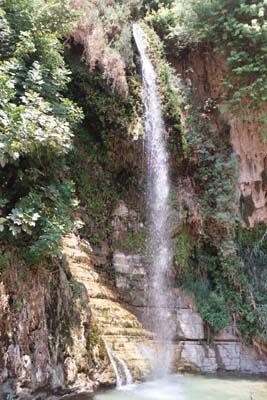
The LORD answered Moses, “Walk on ahead of the people. Take with you some of the elders of Israel and take in your hand the staff with which you struck the Nile, and go. I will stand there before you by the rock at Sinai. Strike the rock, and water will come out of it for the people to drink.” So Moses did this in the sight of the elders of Israel. Exodus 17:5–6
Notice that God says, “….take in your hand the staff with which you struck the Nile.” This staff had also recently been turned into a serpent before Pharaoh’s eyes, and it had been stretched out to part the waters of the Red Sea. So the people would have immediately known that God was about to do something big.
For years Moses had used his staff in the deserts of Midian, leading his sheep and finding water for them. He may have even used it at times to strike rocks for water, because we know that in this area of the desert porous, water-bearing limestone was present which, with the crack of a sharp blow, could release a large flow of ground water. (1)
It was here at Mt. Sinai forty years earlier that God had spoken to Moses from the burning bush, calling him to lead the Israelites out of Egypt. Remember the story from Exodus 4, in which he questioned God saying,
“What if they do not believe me or listen to me and say, `The LORD did not appear to you’? Then the LORD said to him, ‘What is that in your hand?’ … ’A staff’ he replied … The Lord said, ‘… take this staff in your hand so you can perform miraculous signs with it.”
Is it a coincidence that in both cases, Moses was pleading with the Lord about what to do with the people? Is it a coincidence, that in these cases, God used this staff to work miracles relating to water and deliverance? Of course we know that the Lord can do any miracle by simply speaking a word if he chooses too, but in this case, he added to the impact by choosing a visible symbol which recurs throughout Scripture.
Ultimately, it points to his to his power and kingship in Jesus, the source of all living water!
The scepter will not depart from Judah, nor the ruler’s staff from between his feet, until he comes to whom it belongs and the obedience of the nations is His.
Genesis 49:10
(1) JPS Torah Commentary on Exodus, N. Sarna, p 94.
 In this story we find the Israelites “grumbling” to Moses and Aaron about their present circumstances. The Hebrew meaning behind this translation conveys a much stronger picture, that of a riotous mob wanting to kill their leaders. I find myself quickly judging the Israelites, thinking that since they had just been brought out of the land of slavery, how could they be complaining already? After all, they had seen the mighty hand of God on the night of Passover, they had experienced the parting of the waters of the Red Sea, manna appeared with the dawn, quail fell from the sky, and they had benefited from many other miracles. How could they be so ungrateful as to be complaining about thirst?