What’s the Good News?

by Lois Tverberg

How beautiful on the mountains are the feet of those who bring good news, who proclaim peace, who bring good tidings, who proclaim salvation, who say to Zion, “Your God reigns!” (Isaiah 52:7)

Some kinds of news have the power to change our lives overnight — the birth of a baby, the diagnosis of cancer, the closing of a factory. The news of the end of a war or toppling of an evil government can mean new life for millions. We remember with great joy the end of World War II, the fall of the Berlin Wall, and even the toppling of the statue of Saddam Hussein. People who had lived in fear of torture and murder for decades said that they felt like they had been “reborn.” It was as if a nightmare was suddenly over and a new day had come.

Interestingly, the Hebrew word besorah, which we translate to “good news,” has exactly that connotation. It is news of national importance: a victory in war, or the rise of a powerful new king. The word was used in relation to the end of the exile (Isaiah 52:7) and the coming of the messianic King (Isaiah 60:1). Often it is news that means enormous life change for the hearer.

In Greek, there is an equivalent word, euaggelion, which we also translate as “good news, glad tidings, or gospel.” It also describes historic news of national importance. One place where this term is used is in the story of the angels who bring the news about the birth of Christ:

But the angel said to them, “Do not be afraid. I bring you good news of great joy that will be for all the people. Today in the town of David a Savior has been born to you; he is Christ the Lord. (Luke 2:10-11)

This announcement has a fascinating context. In Jesus’ time, there was a yearly announcement of the birthday of Caesar as “the euaggelion to the whole world.” The Roman Empire considered it great news to remind people of the ascendancy of this king and his reign over the known world. In the light of this, we see that the angels were doing the same thing, but in a much greater way — making an official proclamation to the all the nations about the birth of the true King of Kings, and the arrival of a new kingdom on earth.

When we learn that the word “evangelize” comes from euaggelizo (related to euaggelion), we can see the true power of the “good news” of the coming of Christ. Victory has been won in the war against Satan; and Christ, the true King, has come into power. This new King has come to extend an invitation to enter his kingdom and live under his reign. Like any regime change, the word “good” is far too bland to express the impact of this news that brings eternal life to its hearers. May the news of this King spread everywhere on earth!

~~~~

This article is an excerpt from Listening to the Language of the Bible, available in the En-Gedi bookstore

Photos: Jon Tyson on Unsplash

True Knowledge of the LORD

by Lois Tverberg

“For the earth will be filled with the knowledge of the LORD, as the waters cover the sea.” (Isaiah 11:9 NIV; also Habakkuk 2:14)

The Bible often talks about having the “knowledge of the Lord,” and we may wonder what knowledge God desires of us. Does this really refer to a perfect doctrinal understanding of the godhead? How much theological expertise do we need?

We as Christians often focus on knowledge by defining ourselves in terms of our creeds. Yet as much emphasis as we place on knowledge, we know that information alone is not God’s ultimate goal.

Paul points out that “knowledge puffs up, but love builds up” (1 Cor. 8:1). James points out that even demons know the truth about God, and it makes them shudder (James 2:19). Indeed, Satan could probably give correct answers to some of the world’s most difficult theological questions, perhaps more than any other created being, but he does not have a saving knowledge of Christ.

Indeed, sometimes our desire to “know” can lead us into problems. We can do damage by trying to know what really can’t be known. We’ve all heard of people going through great difficulties who are hurt by others who claim to “know” why their prayers aren’t being answered. Such people discourage their hurting friends by falsely accusing them of sin or lack of faith, as Job’s friends did.

God doesn’t require that we have all the answers about why he acts as he does. It is interesting that Job expressed his anger with God and his confusion about why he permitted all sorts of evil on earth, and God declared that Job spoke “truthfully.” On the other hand, God was quite angry with Job’s friends whose cold-hearted theology had all the answers worked out. Although Job’s friends were trying their best to be theologically correct, they did not know the mind of God:

The LORD said to Eliphaz the Temanite, “My wrath is kindled against you and against your two friends, because you have not spoken of Me what is right as My servant Job has. (Job 42:7, NASB)

From Job’s case, it seems that sometimes our honest questions are more truthful in God’s eyes than a claim to have all the answers.1

We also see that our desire to read the mind of God can undermine what he has revealed in his word. For instance, people ponder God’s control over the future and sometimes conclude that if God foresees all and is unchangeable, there is no reason to pray. As a result, they can become fatalists and give up. However, the clear words of Jesus are that we should always pray and never give up (Luke 18:1)! Our own logic may lead us to a wrong conclusion. We are wiser to admit that we cannot know the depths of God’s mind, and conclude that if Jesus tells us to pray, our prayers are worthwhile and effective.

A Rabbinic Observation about Knowledge

The rabbis had some wisdom on this issue. They asked the question, “Why do the Scriptures begin with the second letter of the alphabet rather than the first?”2 (In Hebrew the first word of Genesis is breisheet, which starts with the Hebrew letter bet, which is the second letter, after aleph.) Their insightful answer was, “To show that the Scriptures do not answer every question, and not all knowledge is accessible to man, but some is reserved for God himself.”

They also pointed out that the letter bet is closed on the right side but open on the left. Since Hebrew is read from right to left, it appeared to them that the Scriptures start with a letter that is open in the direction of the reading, but closed toward the beginning of the text. It’s as if there is a one-way sign saying that we need to start here and move forward through the Scriptures.

The point of this midrash, “interpretive story,” is not to discourage study and inquiry, but to note that God has chosen to allow some things to remain a mystery to man. Even in the very first sentence of the Bible, there is no attempt to answer the question of where God himself came from. Pagan creation accounts always began with stories about how the gods themselves came into existence, feeling the need to address that question. God in his majesty does not give every answer, just as he did not give Job every answer for the questions he asked.

Greek intellectualism has influenced our thinking, and it tends to lead Christians to believe that we are capable of understanding anything we might ask God: but just as Moses could not see all of God’s glory and live, so too would we be overwhelmed by the enormity of God’s thoughts. We forget that whole libraries have been written to describe the workings of just one cell of the human body, and that God designed everything from electrons to galaxies. We are just specks in the vast ocean of God’s intellect. We need to realize the wisdom in being able to humbly say, “I don’t know” and letting God alone know some things.

A Hebraic Insight on Knowledge

If we look at the idea of “knowledge” as it is understood in Hebrew, we can have a better understanding of the knowledge that God desires of us. When English speakers use the verb “to know,” we think of our mental grasp of facts. In Hebrew, however, the word for “to know,” yadah, is much broader in scope.

Rather than just knowing information, the Hebrew idea of yadah stresses knowing from experience and relationship, and acting on that knowledge.3 When used in terms of knowing people, it can mean caring for someone, or even mean being intimate sexually. For instance, the very literal King James Version reads:

And Adam knew (yadah) Eve his wife; and she conceived, and bare Cain.
(Genesis 4:1, KJV)

This idea is especially important when we learn about the biblical concept called the “knowledge of God,” da’at elohim. We as Westerners may think this means to prove God’s existence and establish a theological model to explain God’s nature. But the Hebrew view is that “knowledge of God” is having a life in relationship with him. We can see this way of thinking when we compare Christian translations of the Bible with a Jewish translation. The New International Version has:

The Spirit of the LORD will rest on him — the Spirit of wisdom and of understanding, the Spirit of counsel and of power, the Spirit of knowledge and of the fear of the LORD. ” (Isaiah 11:2)

But the Tanakh by the Jewish Publication Society reads:

The spirit of the LORD shall alight upon him: a spirit of wisdom and insight, a spirit of counsel and valor, a spirit of devotion and reverence for the LORD.” (Isaiah 11:2, JPS)

Hebraically, knowledge is not just knowing who someone is, it is devotion to them as well. Jews see knowledge of God as intimacy with God, knowing him as a son does his father, and as a wife her husband. We should think of that when we share our faith. Are we trying to fill people’s minds with facts, or are we bringing people to know the Lord personally? How well do we know him ourselves?

In this context, we can understand the Jewish idea that “study is the highest form of worship”; as Abraham Heschel said, while Greeks (Europeans and Americans) study to comprehend, Jews study to revere.4 When we study God’s word in order to know him intimately and do his will, we are truly honoring God as our Father and Lord, whereas when we study just to fill our brains to become more respected, or to set others straight on what we disagree with them about, it is knowledge that has little use but to make us arrogant.

In the ministry of En-Gedi, we have struggled with how to communicate that our ministry is educational, but devotional in nature; that we want to bring people closer to the Lord by understanding the Bible in its context.

A verse we felt the Lord had given us was: “For the earth will be filled with the knowledge of the LORD, as the waters cover the sea” (Isaiah 11:9 NIV; also Habakkuk 2:14). We had pondered the verse for years, looking for insight that it would give us into our calling. When we read it in the Jewish translation, we finally understood it better. It says that the earth “shall be filled with devotion to the LORD as water covers the sea” (Isaiah 11:9, JPS).

~~~~

This article was based on two chapters of Listening to the Language of the Bible, available in the En-Gedi bookstore

1 Dickenson, A. The Gospel According to Moses: What my Jewish friends taught me about Jesus (Grand Rapids, MI: Brazos Press / Baker Book House, 2003) has a wonderful discussion on bringing our doubts to God, and on dealing with paradoxes: see pp.15-28 and 63-80.
2 Lieber, D. L. Etz Hayim Torah and Commentary (New York: Jewish Publication Society, 2001), p. 3.
3 Wilson, M. R, Our Father Abraham: The Jewish Roots of the Christian Faith (Grand Rapids, MI: Eerdmans, 1989), pp. 287-289. Wilson’s chapter on “The Contour of Hebrew Thought,” especially the idea of “block logic” (pp. 150-153) is also extremely helpful in understanding the way the Bible “thinks.”
4 See the En-Gedi article “Does God Want Us to Fear Him?

Photos: Iñaki del Olmo on UnsplashIlya Repin [Public domain], Priscilla Du Preez on Unsplash

The Bible is like Star Trek

by Lois Tverberg 

Back when I was in school, my friends and I were huge fans of Star Trek: Bible is like Star TrekThe Next Generation. Every Monday morning, all we talked about was the previous evening’s new episode. At first we just focused on the science fiction, discussing how Jean-Luke Picard dealt with whatever strange planetary life form that he had encountered that week.

After a while, though, we became engrossed in the plots that were interwoven into many episodes and would surface again in later programs. Data, the android, would discover one week that his creator had also fashioned an evil twin “brother” named Lore, and weeks later, their relationship would come up in the characters’ conversation. Months later Lore would return, now possessing the “emotion-chip” that Data had dearly desired since he was first built.

Over time we saw that key to enjoying the show was paying attention to the crew’s offhand remarks about the past, and then thinking back to how earlier episodes shed light on the current story. Like any well-written series, each program would tell a good story, but a long-time follower would be able to see how the intrigue grew as the plot thickened over time.

As I learned to read the Bible in its ancient Eastern setting, I discovered that it’s actually a lot like this. Why? Because memory and history were central to the fabric of ancient Eastern culture. The ancients were very aware of ancestral relationships and oral history handed down to them, and used it to understand later events. Especially important to them was the first place they found something, because it usually set up relationships and patterns that would come up again and again.

Being aware of this has greatly enriched my Bible study, because the Scriptures are written with this in mind. As a child, my Bible story book trained me to read the Scripture as a series of short stories, mostly unrelated, each with its own moral lesson.

Only after learning about its Eastern setting did I discover that the Old Testament especially is an epic saga with a delightfully interwoven plot. Sometime the Bible includes stories that hardly seem to be moral examples, and I used to wonder why they were there. But they need to be there to explain the deeper meaning of later events.

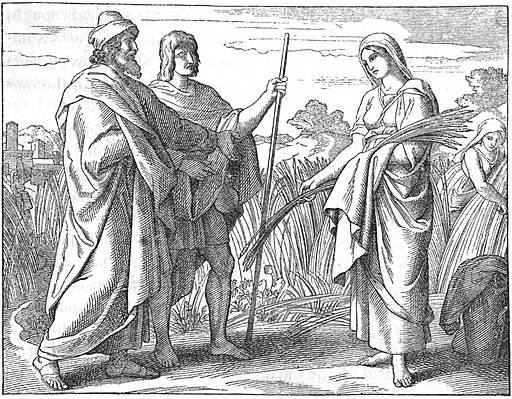
Let’s look at how an ancient person would read the book of Ruth. I used to simply see it as a nice story about a widow who found a good husband because she was kind to her mother-in-law. But if we lived in biblical times, we would be curious about Ruth’s ancestors, and our ears would prick up to the fact that Ruth was a Moabite.

Immediately we’d think of the scandalous past of her people, and it would cast her story in a different light. We’d recall that when the weary Israelites were journeying to the Promised Land, the Moabites lured the Israelites into sexual immorality and worshipping idols (Numbers 25:1).

From that time on, the Moabites were associated with sexual immorality, even more disgusting because it was how they worshipped their “gods.” Because of that sin, God declared that Moabites were barred from being a part of the assembly of Israel in Deuteronomy 23:3. Was their sin ever forgivable, we’d wonder?

Then we’d think back to the origins of the Moabites in Genesis 19:30-38. After Sodom and Gomorrah were destroyed, we read the not-so-nice story of when Lot’s daughters got their father drunk so that they could become pregnant by him, since their husbands had refused to leave the city and died. One of Lot’s daughters gave birth to a son named Moab, and he became the father of the Moabite people. So that’s why the Moabites are so immoral! This would make complete sense to us, because we’d expect that people would be defined by their ancestry.

Keeping these ideas in mind, now let’s turn to Ruth. She was a Moabite woman who had returned to Israel with her mother-in-law after her husband died. An ancient listener would immediately wonder, was she as immoral as those who came before her? She said that she would worship the God of Israel, but would God ever accept her? We even find her in the same situation as Lot’s daughters! Like them, she was a widow who desperately needed children. Naomi even told her to approach Boaz when he was sleeping outside by his harvest, after he had eaten (and drunk) his fill.

Unlike her ancestors, however, Boaz proclaimed that she was a virtuous woman (Ruth 3:10). He then married her, and her son became the grandfather of King David. Not only that, but Ruth even appears in Matthew 1:5 as part of the line of Christ! She turned from her people’s unseemly past to embrace the God of Israel. Not only did he accept her and cleanse her from her history, but he gave her a key role in his supreme act of salvation! Those of us who struggle with an embarrassing family history or an immoral past should rejoice to see how God redeemed Ruth and used her for his wonderful purposes.

Understanding how texts interrelate has given me a whole new perspective on reading the Bible. When I used to read the stories by themselves, some of them frustrated me because they didn’t show me how to live. But the difficult ones have a far deeper purpose. They illustrate how the terrible sinfulness of man runs throughout history, but then how God graciously intervened to bring Christ into the world. We need to read with the eyes of an ancient person in order to see how that message is woven into the fabric of the Bible from beginning to end.

~~~~

Photos: NBC Television [Public domain]; The story of the Bible from Genesis to Revelation [Public domain]

Jesus’ Surprising Answer

by Lois Tverberg

When Jesus was asked the question, “What must I do to inherit eternal life,” the conversation leads to an answer that most Christians would find unacceptable, or at least confusing. It sounds as if by obeying the commandments, or even by loving God and our neighbor, we can somehow earn our own salvation!

We read this conversation in Luke 10:

On one occasion an expert in the law stood up to test Jesus. “Teacher,” he asked, “what must I do to inherit eternal life?” “What is written in the Law?” he replied. “How do you read it?” He answered: “`Love the Lord your God with all your heart and with all your soul and with all your strength and with all your mind’; and, `Love your neighbor as yourself.'” “You have answered correctly,” Jesus replied. “Do this and you will live.” Luke 10:25-28

One explanation for Jesus’ response is that because the law expert is testing Jesus out of hostility, Jesus is deliberately affirming his “wrong” answer, so that later, when he realizes his inability to keep these commands perfectly, he will see that he must lean on God’s grace and just believe.
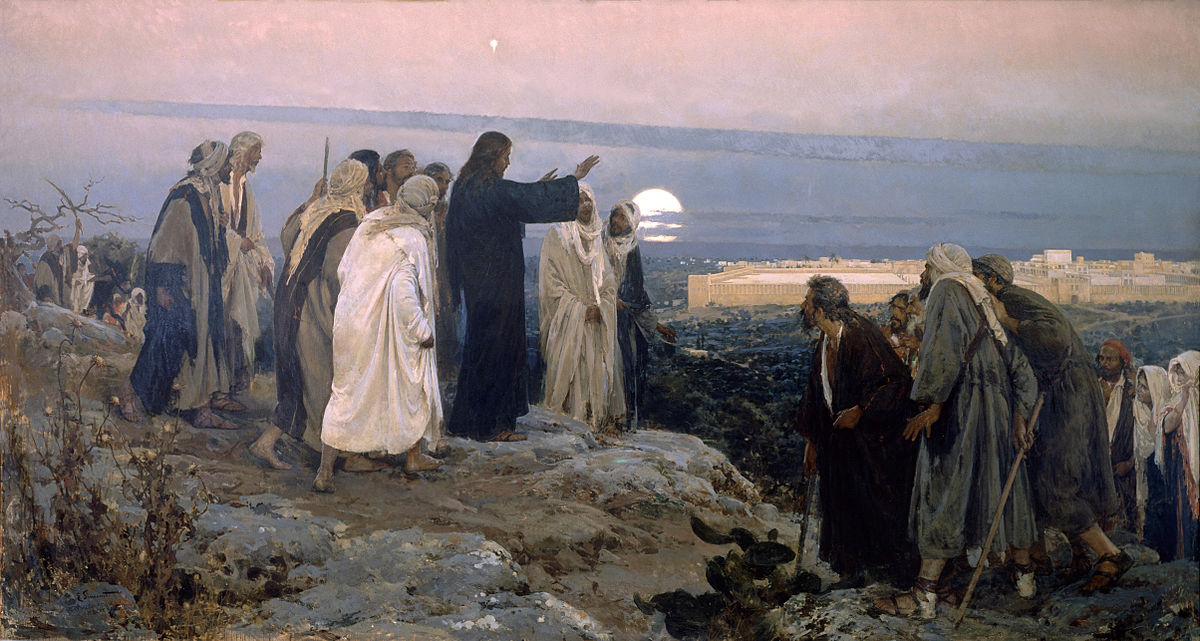
Jesus and Disciples

Most likely this is not what was going on. If this is true, it means that Jesus was playing a game with the lawyer, and that his words must be read knowing that no one ever could actually do what he just said to do. While this has satisfied some Christians, having additional information from Jesus’ first century Jewish context can lead to a better reading of this text that explains why Jesus accepted the answer without hidden qualifications.

We should start with the assumption that many times when other rabbis “tested” Jesus, it was not done with hostile intentions. The rabbinic style of public discussion from Jesus’ time even up to the present has been to pose a difficult question with the expectation of debate. A story is even told of a rabbi who greatly mourns the passing of his strongest adversary, because he had lost his best way to sharpen his intellect.1

We tend to assume that every conversation between Jesus and religious thinkers was antagonistic, and hear their questions as legalistic or manipulative. But several questions, like whether divorce was permissible, or what was the “greatest commandment,” were actually important discussions already permeating the rabbinic community of Jesus’ time.2

Love the Lord Your God

The key to understanding Jesus’ affirmative response is to look at the context of how the lawyer’s response was understood in that time. The first line of his answer says, “Love the Lord your God with all your heart and soul and strength and mind,” and comes from Deuteronomy 6:5. We hear “love” as inward affection, and it does mean that. But in Hebrew, the verb “love” can also refer to the outward display of committedness to another. It is to “act lovingly toward” or “to honor and be loyal to.” It was even used in covenants between kings after a war, when one would promise to “love” the other, meaning to show uncompromising loyalty to the other.3

Why is this important? Because then the statement “You shall love the Lord…” then becomes a statement of life commitment to God, and faithfulness to a relationship with him. This is very close to the Christian understanding that we need to have a personal relationship with God for salvation.

Interestingly, the rabbinic term for this idea — to commit yourself to a personal relationship with God, was to “receive the kingdom of Heaven,” very close to what Jesus referred to in his preaching. Why? The word “kingdom” refers to God’s reign or authority, and “Heaven” is a respectful euphemism for God. When we receive the reign of God, what we are actually doing is enthroning him as our king, committing our lives to be under his reign.

This yields a clue as to why Jesus spent so much of his ministry proclaiming the “kingdom of Heaven,” in the sense that he had come to open the way for all people to have a relationship with God through atonement by his blood, and that relationship could be described as “entering under God’s reign.”4

Another important thing about the lawyer’s response was that he was quoting from the Shema, the “pledge of allegiance” that Jews said as a statement of commitment to their relationship with God. The first line is “Hear, O Israel, the Lord is your God, the Lord alone.” According to the Jewish Publication Society, the emphasis is not actually on proclaiming that “God is one,” a creed of monotheism (as is often said), but on the demand of utter loyalty between God and his people — that he alone is their God.5

Obedience Follows Relationship

It may be surprising to some that rabbinic thought of Jesus’ time embraced the idea that salvation comes by faith rather than by works, and they even saw that expressed in the Shema. They understood that the relationship with God must always come first, and only after we have that do we obey God’s commandments.

In the Mishnah6 there is a sermon based on the how the Shema is recited. A  person always begins with Deut. 6:4-9, which begins with “Hear O Israel, the Lord is Your God, the Lord alone.” Next they recite Deut. 11:13-21, which begins with the words, “So if you faithfully obey the commands I am giving you today…” The rabbi said,

“Why do we always talk about God being our Lord before we say the part about obeying the commandments? Because we must first receive the kingdom of Heaven (meaning “enthrone God as our king,” or establish our relationship with him) and only then take on the yoke of the commandments.”7

We do not earn our relationship, we receive it as a gift from him, and the laws are not for earning God’s favor or getting into heaven, but for learning how to live to please him. One creative rabbi imagined that King David may have been thinking that when he wrote Psalm 141:1:

King David said, “Some trust in their fair and upright deeds, and some in the works of their fathers, but I trust in you. Although I have no good works, yet because I call upon you, you answer me.”8

Love your Neighbor as Yourself

The other commandment that the lawyer mentioned in Luke 10, “love your neighbor as yourself,” also has special significance. It is a quote from Leviticus 19:18, and it was singled out in ancient Jewish culture before we hear it from Jesus. It has a rare word, ve’ahavta, “and you shall love,” in common with that of words of the Shema that shows total commitment to God, “And you shall love the Lord your God…”

Even before Jesus’ time, those two verses were thought to be linked, in a poetic way, so that the way you expressed your total love and commitment to God, who you can’t see, was by showing love to your neighbor, who you can see. This is certainly a central teaching of Jesus too, and the overwhelming importance of this command is echoed in the rest of the New Testament. Peter says “above all, love one another” (1 Peter 4:8), and in the letters of John, that “this was the teaching you have heard from the very beginning – to love one another” (1 John 3:11).

It appears that this idea may have already been circulating in Jewish culture before his time, and the lawyer was repeating it to Jesus. If Jesus also had the first century understanding that loving your neighbor was the clearest expression of your commitment to God, he would have accepted the lawyer’s words as a way of describing how to live out your relationship with God in obedience and authenticity, by showing God’s love to those around you. Thus, the lawyer gave a very good answer, using first century Jewish terminology to say that we need to commit ourselves to the Lord and live our faith out wholeheartedly. And Jesus responds, “Yes, do this!”

The questioner then goes on to ask, “who is my neighbor,” which also was a legitimate question that was debated at the time, and Jesus gives brilliant insight to this too.9

 

The Challenge of A Different Understanding

Although this may be a challenge to our traditional Christian view, it suggests that there was some brilliant thinking going on before Jesus’ time, as God was preparing his people for the coming of his Son.

Certainly if Jesus was going to raise up a congregation of many thousand followers out of this Jewish nation (Acts 21:20), God needed to be preparing their hearts for their Messiah. Studying their thinking allows us to see Jesus’ answer as straightforward and clear. He affirms that we need to have a personal relationship with God, and show our commitment to him by loving others in the world around us.

~~~~

This essay is based, in part, on a talk given by Dr. Randall Buth at Mars Hill Bible Church on October 17, 2003. 

~~~~

1 Page xiii, Jesus the Jewish Theologian, by Brad Young. Hendrickson, 1995

2 See the article, “Divorce and Remarriage in Historical Perspective” by Steve Notley at www.jerusalemperspective.com.

3 JPS Torah Commentary on Deuteronomy, by Jeffrey Tigay. Jewish Publication Society, 1996, p 77.

4 See the En-Gedi Bible commentary article, “What is the Kingdom of Heaven?

5 Excursus 10: The Shema in the JPS Torah Commentary on Deuteronomy, p 438-440.

6 The Mishnah is a book of legal rulings and commentary on the Torah written down about 200 AD that is record of sayings that go back to before the time of Jesus.

7 Berachot 2.2, Mishnah.

8 Midrash Psalms 141 (ed. Buber, pp. 530-531).

9 See the En-Gedi Director’s article, “Loving your Neighbor, Who is Like You.

Photos: Museum of MálagaChris Gallimore on Unsplash; Jon Tyson on Unsplash

Learning About Prayer From Jesus

by Lois Tverberg

It was at this time that He went off to the mountain to pray, and He spent the whole night in prayer to God. Luke 6:12

Jesus was a man of prayer. He stayed up all night in prayer, arose early to pray, and taught his disciples to pray. How did people pray in Jesus’ time, and how did he probably pray? Understanding the traditions of Jewish prayer adds depth and meaning to Jesus’ teachings on the subject.

For instance, the prayer that Jesus probably prayed before he broke the bread at the Last Supper was probably something like, “Blessed is he who brings forth bread from the earth.” If the very next thing Jesus says is “This is my body, broken for you,” could he be hinting that just as God brings bread from the ground, he will bring Jesus, the Bread of Life out of the ground? It is an interesting thing to ponder. Our understanding of that passage is enriched by knowing the prayers of Jesus’ day.

Jesus also teaches many parables on the importance of prayer – about the persistent widow, and about the prayers of the Pharisee and the tax collector. We can learn much about the mind of Christ on prayer by grasping his teachings as they would have been understood in his time.

We can be especially enriched by understanding the prayer that Jesus taught us. Although we know it by heart, many struggle with some of the phrases like, “thy kingdom come” and “keep us from evil” that may seem foreign to us. Understanding his prayer in the context of the other prayers of his time will help us pray as Jesus intended for us to pray.

Of course, we need to be not just hearers of the word but doers as well. These articles will only be worthwhile if they inspire you to a new level of prayer, and a more intimate walk with your Heavenly Father.

Photo: Conniemod / CC BY-SA